
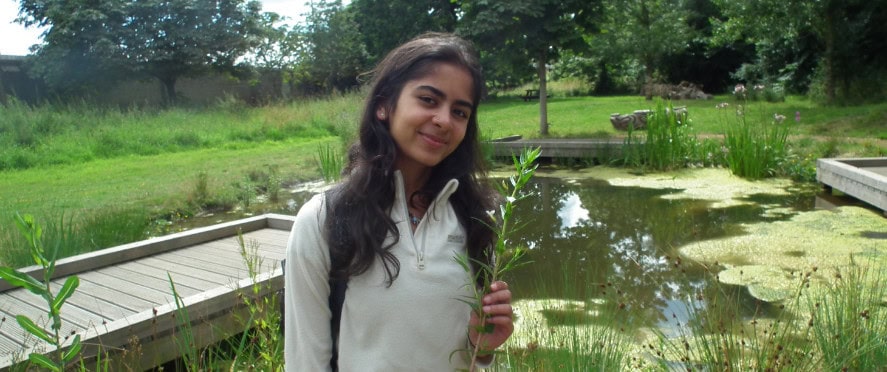
One of our Youth Panel members, Sanchi, attended ‘An Introduction to the Wildflowers and Habitat of Greenwich Park’ in July 2024. She has kindly put together some words about her experience. Applications for our Youth Panel open on the 18th of August.
On the 16th of July 2024, I travelled to Greenwich Park in London for the Field Studies Council course: ‘An Introduction to the Wildflowers and Habitat of Greenwich Park’. As a member of the Field Studies Council’s Youth Panel, I was excited to be able to attend a short course not too far from home, exploring an interesting place with the guidance of a specialist tutor.
Upon arriving at the Field Studies Council Centre in Greenwich Park, we were introduced to our tutor for the course, Dr. Mark Spencer. It was encouraging to see a variety of age groups represented at the course, with my friend and me being the youngest at 18. To begin the course, we stepped outside the building into the sunny Field Studies Council centre garden area, where we spent a lot of time identifying and learning about the variety of weeds, flowers, trees and other plants. Mark’s passion for plants was immediately infectious, encouraging us all to become immersed in the experience.
As a plant enthusiast myself, it was uplifting to be in a relaxed, friendly and encouraging atmosphere where I could connect with others on a common love for nature. Mark encouraged us to be curious and ask questions, which I did many times! Compared to sitting at home and reading a botany book, it was much more impactful to be surrounded by plants to learn about, with a botanical expert. Some things are only possible in person, such as when Mark encouraged us to use all our senses to identify a plant, instead of relying on sight alone, which can sometimes be misleading and therefore dangerous. We walked around touching, smelling, and even tasting the plants whilst learning about the unique and amazing adaptations of many plants that we see every day and may dismiss as ‘ordinary’.
For example, who would have thought that the elegant twist in the trunk of many trees, such as the oak tree we saw, is actually a structural adaptation to make them more flexible during windy weather, preventing them from snapping? I noticed the bark was peeling off in thin layers from one tree and asked Mark why that might be. As an A-Level Biology student, I was fascinated to learn that trees accumulate toxins in the bark and then shed them as a method of defence.
Mark also enlightened us about the distinction between native and non-native species, and the careful consideration with which botanists use the term ‘invasive’ for plants. We learnt that many plants in Britain are non-native, but this does not necessarily make them invasive. Only around 10-15% non-native plants spread and become non-native invasive species, an interesting and important piece of information. Mark did outline the dangers of non-native invasive species such as the Tree of Heaven that we encountered, telling us about the species’ dangerous impacts on local biodiversity and ecology.
Before entering Greenwich Park, I passed by Blackheath, thinking it a dull and desolate area. ‘Why don’t they grow some nice trees here?”, I wondered. One of the first topics Mark discussed was the importance of lowland heathlands, such as Blackheath, especially in London. Blackheath is an important acidic grassland habitat, providing a home for native reptile species such as adder, grass snake, slow worm and some lizards. To remove grass from Blackheath and plant trees instead would kill soil microbes and fungi, homogenising the biodiversity of Blackheath, parts of which are designated Sites of Specific Scientific Interest (SSSI).
Whilst learning about the environment around us, we not only questioned the workings of nature but also the human impacts on the environment in the past and how these have created the present disconnect from nature and climate crisis. We briefly talked about the devastating consequences of ill-informed conservation and the environmental problems faced at all sizes, from pond ecosystems to the global climate. However, we wondered hopefully whether we could learn from the plants that are so well adapted to their environments, how to mitigate the impacts of the climate crisis. For example, we could plant more heat-tolerant species of plants in the UK, whilst ensuring they are related European species in order to preserve and use genetic diversity to the advantage of nature and people in the future.
Furthermore, as a young woman of British Indian ethnicity, I was grateful to be able to represent the interests of a diversity of people in the natural world, in a traditionally male and less diverse discipline. This course reaffirmed my belief that anyone who is interested in the natural world should have the opportunity to explore it and build connections with nature, allowing diverse and uniquely important perspectives to arise in the study of the natural world. As I continue to be part of the Field Studies Council Youth Council, I aim to help increase the involvement of all people with the natural world through learning about it with fellow naturalists, guided by tutors.
As well as all the amazing facts shared and thoughtful discussions had, what really stuck with me was the interest and connection that we formed in those few hours in nature, encouraging us to appreciate the intricacy and complexity of our natural world. I am grateful to the Field Studies Council and Mark for enabling an informative, enjoyable and inspiring session which reminded me to always remain open to observing the wonders of nature and stay curious, as we have much to learn yet!
Find out more
Our Youth Panel is a diverse group of proactive young naturalists aged 16-25 from across the UK. Youth Panel members fulfil a strategic role, sharing perspectives on barriers and opportunities for youth engagement across Field Studies Council education and programmes.
If you are interested in learning more about or wish to apply to our Youth Panel, click here.