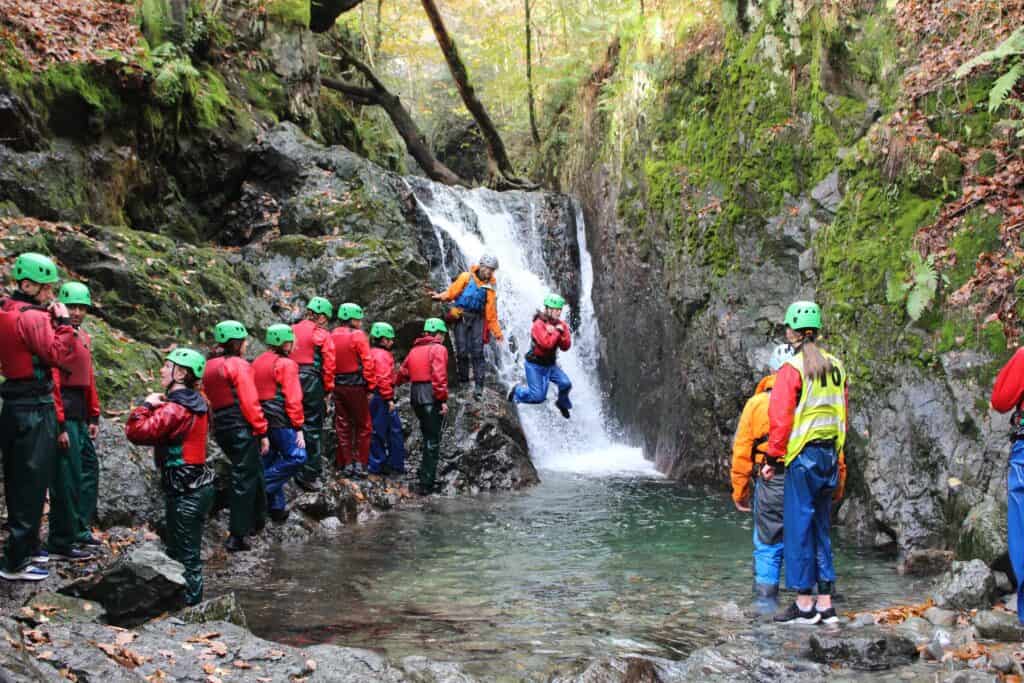
Alan Milburn’s interim Young People and Work review delivers a stark warning: the UK risks creating a “lost generation” of young people unless urgent, systemic reform is undertaken. Here, our Adventure Learning Lead Matt Healey sets out our response to the landmark Millburn review and explains why outdoor learning must be at the heart of any meaningful solution.
More than one million young people aged 16–24 are currently classified as not in education, employment or training (NEET), and that figure could rise to 1.25 million within five years.
Matt says “Through our work with more than 100,000 learners each year, across fieldwork, environmental science, and adventure learning, we see that disengagement among young people is rarely about motivation.
“It is about connection: connection to learning, to self-belief, to opportunity, and to place, and this is crucial.
“One of the most important insights in Milburn’s review is that around 84% of young people classified as NEET actually want to work or train. This is not a story of disengaged young people lacking aspiration. It is, as Milburn puts it, a “whole-system failure” brought about by a disjointed set of education, employment, health, and welfare structures that struggle to support young people through the transition to adulthood.
“At Field Studies Council we’ve long argued for the real need for not just joined up thinking but joined up policies.
“A significant proportion of NEET young people already hold Level 3 qualifications or above, yet remain excluded from the labour market. This points to a critical gap, not between qualification and completion, but between attainment and employability. Building confidence, resilience, and real-world capability matters just as much as holding a certificate.”
“The Milburn review is also clear that mental health has become a primary driver of youth disengagement, not a secondary consideration. Rising anxiety, neurodiversity, and long-term health conditions are reshaping who participates in post-16 education and who does not.
Outdoor learning — the key to reframing opportunity for young people beyond NEET
“This is where outdoor, nature-based adventure learning has a distinctive role to play. By situating learning in outdoor, experiential contexts, space is created for young people to rebuild confidence, reduce anxiety, and re-establish a sense of competence and belonging. These are not peripheral benefits but instead pre-conditions for meaningful re-engagement.
“Outdoor learning is also, by design, relational. It relies on trusted adults, peer collaboration, and shared challenges. In a system described by Milburn as fragmented and impersonal, that relational dimension is essential.
“Where the current system operates in silos, outdoor and adventure learning can bridge the divides, simultaneously delivering curriculum outcomes, building employability skills, supporting wellbeing, and connecting young people to real-world contexts and environments.
“Across our network of field centres, we are already delivering the kind of integrated, skills-focused provision that Milburn’s review calls for, and we are investing in new pathways to expand that offer.
“Our Young Darwin Scholarships provide funded opportunities for young people to develop practical fieldwork, ecology, and environmental science skills. These annual scholarships build specialist knowledge and sector-relevant experience that opens doors to careers in the green economy. The level of demand speaks for itself with the programme over-subscribed year on year.
“We also run an established tutor apprenticeship programme, supporting the development of the next generation of outdoor educators, people who will go on to inspire thousands of learners in the years ahead.
“And we are now actively developing activity instructor apprenticeships, planned for introduction in 2027, creating further structured pathways into careers across outdoor learning and adventure education.
“These are not supplementary add-ons. They are a direct response to the structural gap Milburn identifies.
“However we all know that addressing the NEET challenge requires more than targeted programmes. It demands a re-evaluation of what constitutes meaningful education, particularly for young people at risk of disengagement.
“Outdoor and adventure learning must move from the margins to the mainstream. For disadvantaged learners, access to these experiences should be viewed as an entitlement, not an optional extra. Short-term interventions, while valuable, are insufficient on their own. Outdoor learning is most effective when it is embedded across curriculum pathways, careers education, and personal development frameworks
“If we are serious about improving social mobility, strengthening our workforce, and supporting the wellbeing of young people, we must invest in approaches that create connection, build confidence, and open pathways.”