
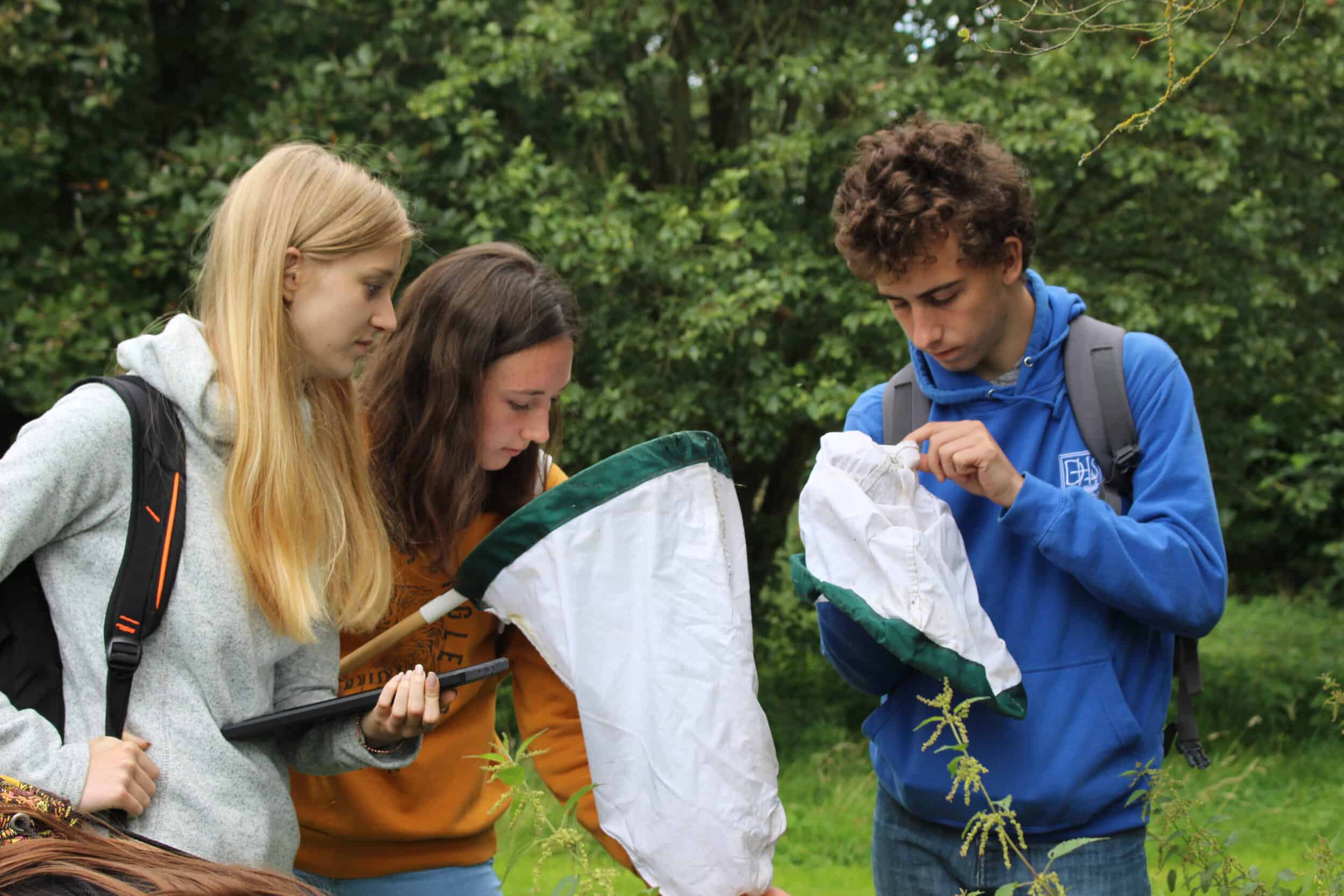
A 5-day IB ESS course offers an unrivalled opportunity for students to develop their practical skills and deepen their understanding of ecological syllabus content in a variety of inspiring habitats before successfully undertaking an individual investigation for their internal assessment.
A wide range of mathematical skills are embedded into every course, including a variety of graphical forms, calculations such as Simpson’s index of diversity, standard deviation, uncertainties and percentage error.
Example Timetable
The following is an example of how a 5-day course might look. Our courses are as flexible as possible to meet your requirements, with other topics and skills able to be substituted into this timetable. There will be some variation between what is offered at specific centres due to habitat availability.
Day 1 Arrive MiddayWelcome by staff, centre tour and introduction, pre-course meeting of FSC staff and teachers, allocation of wellies and waterproofs as appropriate.
Afternoon and eveningImmersion in Ecology
A half day introductory session which is used to immerse, engage and inspire students in ecological skills and environments. Current ecological ‘hot topics’ and synoptic links are introduced, and students are challenged to question the world around them.
Day 2 MorningEcological Energetics
An investigation looking at energy flow and the efficiency of energy transfer within an ecosystem, either in freshwater or on the rocky shore, depending on the centre.
Afternoon and eveningBiodiversity
Students will use random sampling to compare two habitats, calculate species diversity. This could be done in various habitats, including rocky shore, woodland, heathland or moorland depending on the centre visited.
Day 3Succession, carbon and water
A full day session investigating succession using systematic sampling. Students will measure abundance and distribution of species, and assess the impact of succession on the carbon and water cycles.
Day 4Individual Investigations – Personal Engagement and Exploration
Students will plan, justify and carry out their own ecological investigation for internal assessment. They will identify a research question, develop a methodology, including a trial where appropriate, carry out a risk assessment, and collect data.
Day 5Individual Investigations – Analysis and Evaluation
This session allows students time to process and analyse their own data, and research and reference their findings with the support field centre staff and resources.
Depart Midday
How this course fulfills the specification
Detailed coverage of biological content from:
Topic 2. Ecology Topic 3. Biodiversity and conservation Topic 4. Water Topic 5. LandInternal Assessment
Our courses will provide students with the opportunity to develop their practical skills and knowledge and apply these successfully to independently undertake a independent investigation for internal assessment. Through first-hand experience in a variety of inspiring habitats students will be encouraged to demonstrate personal engagement with the exploration of their investigation. The course will provide a context for their research question and encourage them to apply their results to a broader environmental and/or societal context.
Maths and Statistical Skills
Our courses include a wide range of applied maths and graphical skills and, depending on the topics covered, can cover the following statistical tests: Student’s t-test, Mann-Whitney U, Spearman’s rank correlation coefficient and the chi-squared test. Students can also calculate Simpson’s index of diversity using their own data.
Added value of this course
Why Choose Field Studies Council?
-

Expert tuition by fully trained staff
-

Stunning locations across the UK
-

Outstanding curriculum knowledge
-

Rigorous health and safety procedures
-

Support before and after your visit
-

Free places for visiting staff