
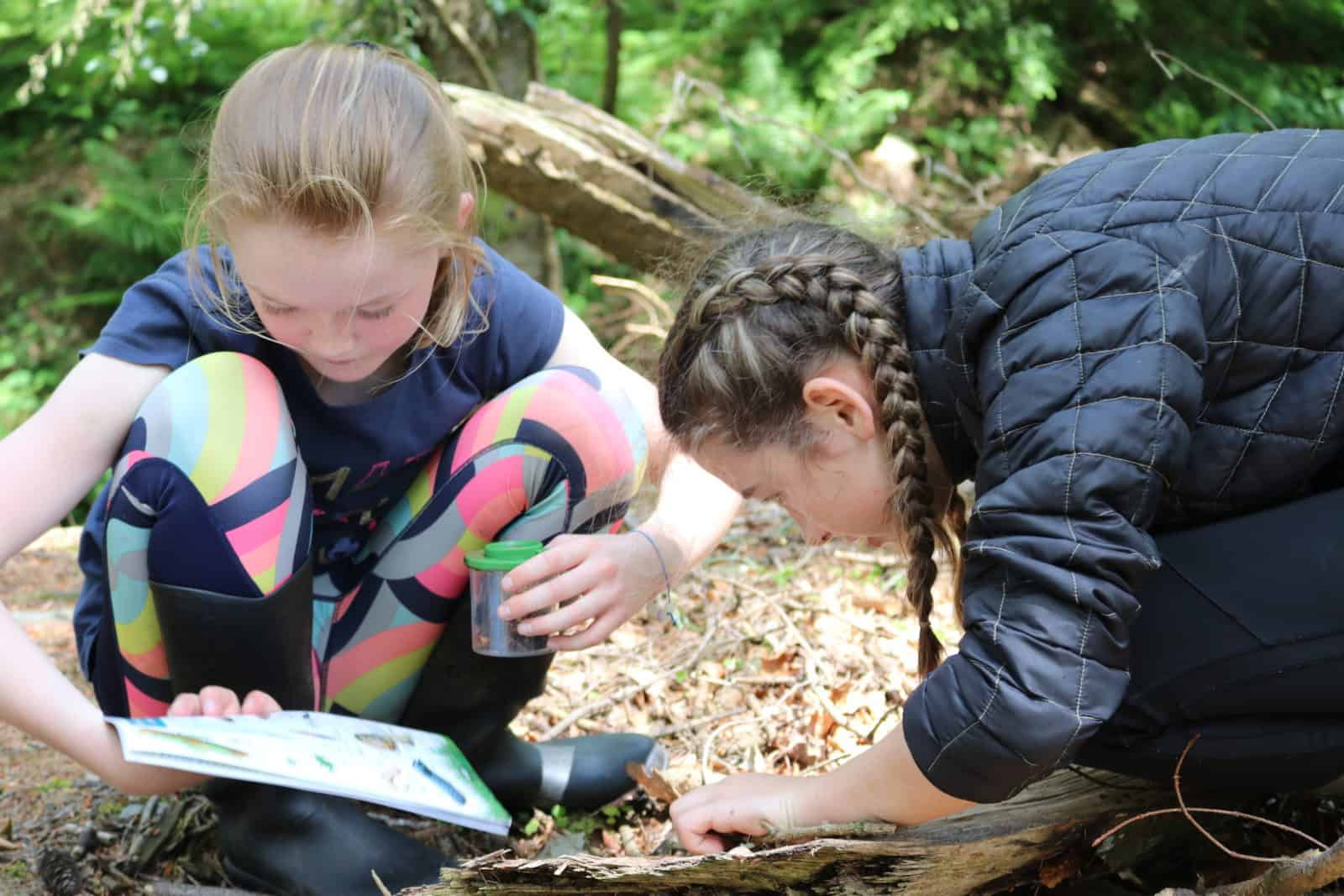
Students will work scientifically to explore different habitats to find out what animals are living there and how they are adapted to their habitat.
Students will collect invertebrates using a range of different techniques, identify and classify them using keys. They will classify animals into commonly found invertebrates such as insects, spiders, snails and worms. They will plan and perform a small scientific enquiry to compare data relating to where animals are found within the habitat and consider environmental variables. This will all be delivered in a fun and engaging way, through hands-on activities, discussion and scientific investigation.
Learning Objectives
- State the differences between two habitats and the invertebrates found within these habitat types.
- Classify animals into commonly found invertebrate groups.
- Identify how groups of invertebrates are adapted to the habitat they live in.
- Observe and collect a range of invertebrates showing care and consideration for their welfare.
- Choose the most appropriate scientific equipment to take measurements and explain how to use it accurately.
Example Timetable
The course normally runs 10am – 2.30pm. There will be an approx. 30 min lunch slot, the timing will depend on the final agreed course programme.
Pre visit /prior learning
- No prior knowledge is required to attend this day.
- Optional – What adaptation is. How animals can be adapted to their environment in different ways.
Welcome and Introduction
- Overview of the day and the habitats we will be investigating today. What animals might we expect to find there? How do we identify them? What different environmental conditions do we expect to find in our different habitats. How might the animals that live there be adapted to these conditions?
Morning Session – Habitat 1
- The children will plan a small investigation in groups.
- Children will collect invertebrates from one of the habitats below using a range of suitable
equipment.
- In the woodland, under a log and leaves
- From the meadow using sweep nets and by shaking vegetation
- From the pond using pond nets - The children will use scientific equipment to measure abiotic factors, for example, light, air temperature and soil moisture.
- Using classification keys, they will identify the invertebrates.
- We will identify producers, predators and prey and create a food web.
- We will observe and discuss how animals have adapted to survive.
Afternoon Session – Habitat 2
- Children will collect invertebrates from one of the habitats below using a range of suitable equipment.
- In the woodland, under a log and leaves
- From the meadow using sweep nets and by shaking vegetation
- From the pond using pond nets - The children will use scientific equipment to measure abiotic factors, for example, light, air temperature and soil moisture.
- Using classification keys, they will identify the invertebrates.
- We will identify producers, predators and prey and create a food web.
- We will observe and discuss how animals have adapted to survive.
Plenary
- Review of the day, what the children have observed and learnt.
Depart
Future learning/follow up
- An exploration into how the invertebrates have evolved to adapt to their habitats. Observing and raising questions.
Habitats Available
Amersham - Woodland/Grassland/Ponds
Bishops Wood - Woodland/Meadows/Ponds
Birmingham Parks - Woodland/Grassland/Ponds
Epping Forest - Woodland/Meadows/Ponds
London: Bushy Park - Meadows/Ponds
London: Greenwich Park - Woodland/Meadows/Ponds
London: Regent’s Park - Woodland/Meadows
London: Queen Elizabeth Olympic Park - due to construction works these will vary
London: Beckenham Place Park - Woodland/Meadows
How this course fulfills the specification
Living things and their habitats
- Describe how living things are classified into broad groups according to common observable characteristics.
- Give reasons for classifying animals based on specific characteristics.
Evolution and inheritance
- Recognise that living things have changed over time.
- Identify how animals are adapted to suit their environment in different ways and that adaption may lead to evolution
Working scientifically
- Planning different types of scientific enquiry.
- Taking measurements using a range of scientific equipment with increasing accuracy and precision, taking repeat readings when appropriate.
Added value of this course
- Develop personal skills
- Have fun
- Be inspired by a passion for the subject
- Build friendships
Related Information
Customer Information
Details of how to book, terms and conditions, policies and procedures, including risk assessments, can be found on our website here.
Variation
The outline shown is indicative. Whilst we do our best to deliver the agreed programme, we sometimes must change the programme due to for example, weather, access to sites, or staffing issues. Most changes are insignificant and will not affect your trip.
Liaison
This programme is designed to meet the curriculum/specification requirements.
Prior to your visit, one of the Tutors leading your group will be in touch via email. This is an opportunity for us to find out more about the group and to make small adjustments to meet your groups needs.
Tuition
Tuition is delivered by Field Studies Council Tutors, with an expert knowledge of the subject and fieldwork locations, and a passion for the subject being taught. The education team are DBS checked, and undergo regular training including in first aid, water safety and risk assessments.
Transport
There is no requirement for transport during the day. All activities take place on site or within walking distance.
Teaching groups
Your group will be divided into an agreed number of taught groups at the point of booking. This may not match your normal classes. Please subdivide the taught group into subgroups in advance of your visit, discuss with the tutor at liaison how many subgroups are required.
Teachers and supporting adults
The school should provide teachers and support staff, or parents, to meet minimum ratios per teaching group. Teachers and adults are expected to participate and support the student's learning. Teachers are expected to manage behaviour & support group management, and to supervise break and lunch times.
What to bring
A kit list can be found on our website here. Please adjust this based on the weather conditions. Ensure the group bring lunch and plenty to drink.
Clothing and footwear
Appropriate outdoor clothing (and waterproofs) should be worn, taking into account the weather forecast. The group will be outside most of the day, even in wet weather. It is advised that long trousers are worn, even on sunny days due to the presence of ticks. We advise wearing sensible footwear – trainers or walking boots that can get muddy.
Why Choose Field Studies Council?
-

Expert tuition by fully trained staff
-

Stunning locations across the UK
-

Outstanding curriculum knowledge
-

Rigorous health and safety procedures
-

Support before and after your visit
-

Free places for visiting staff