
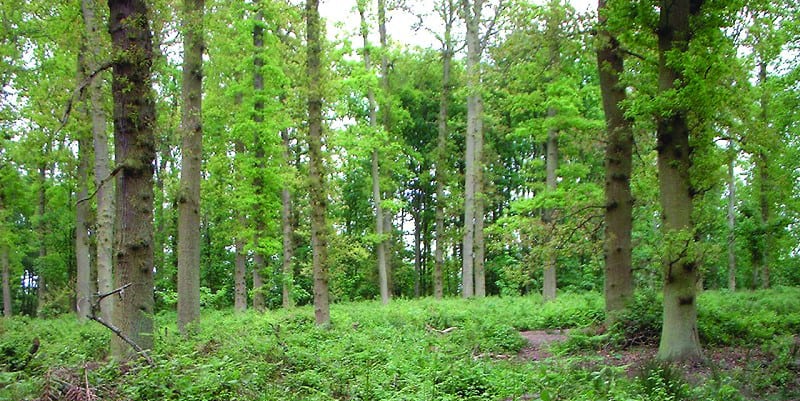
An investigation of how physical and human processes influence vegetation in one or two woodland areas, including the relationship with climate, soil and human activity.
Past management and current practices are discussed. Fieldwork consists of random sampling, measuring biotic and abiotic factors, including plant frequency, canopy cover, and microclimate.
Learning Objectives
- Describe how local factors can affect different habitats
- Demonstrate how to use fieldwork equipment and methods to investigate woodlands
- Use data to form simple conclusions.
Example Timetable
The course normally runs 10am – 3pm. There will be an approx. 30 min lunch slot, the timing will depend on the final agreed course programme.
Pre visit/prior learning
- An understanding of key terminology associated with ecosystems.
- Awareness of the location to be studied.
Introduction
- Welcome and Introduction
- Setting and Sharing Objectives
- Discuss the route for enquiry
- Introduction to woodland ecosystems, including the abiotic and biotic factors present.
Morning/afternoon
- Planning the fieldwork
- In groups, plan the investigation including making predictions, methodology and equipment - Fieldwork, depending on Centre, this may be done at two sites, or along a transect.
- Make observations of the site to be studied.
- Carry out measurements of relevant biotic factors including vegetation and abiotic factors including canopy cover, temperature, soil type, light levels and pH
- Carry out qualitative fieldwork methods e.g. field sketch.
Plenary
- Analysis and evaluation
- A verbal data review to interpret observations, draw conclusions, with reference to predictions.
Depart
Future learning/follow up
- The data collected can be analysed and evaluated.
- Calculate results
- Present observations and data using tables and graphs
- Interpret observations and draw conclusions
- Present reasoned explanations in relation to predictions
- Evaluate data.
How this course fulfills the specification
Key Stage 3 Geography
- Human and physical geography
- Understand, through the use of detailed place-based exemplars at a variety of scales, the key processes in physical geography relating to: weathering and soils
- Understand how human and physical processes interact to influence, and change landscapes, environments and the climate - Geographical skills and fieldwork
- Use fieldwork in contrasting locations to collect, analyse and draw conclusions.
Added value of this course
- Develop personal skills
- Have fun
- Be inspired by a passion for the subject
- Build friendships
Related Information
Customer Information
Details of how to book, terms and conditions, policies and procedures, including risk assessments, can be found on our website here.
Variation
The outline shown is indicative. Whilst we do our best to deliver the agreed programme, we sometimes must change the programme due to for example, weather, access to sites, or staffing issues. Most changes are insignificant and will not affect your trip.
Liaison
This programme is designed to meet the curriculum/specification requirements.
Prior to your visit, one of the Tutors leading your group will be in touch via email. This is an opportunity for us to find out more about the group and to make small adjustments to meet your groups needs.
Tuition
Tuition is delivered by Field Studies Council Tutors, with an expert knowledge of the subject and fieldwork locations, and a passion for the subject being taught. The education team are DBS checked, and undergo regular training including in first aid, water safety and risk assessments.
Transport
There is no requirement for transport during the day. All activities take place on site or within walking distance.
Teaching groups
Your group will be divided into an agreed number of taught groups at the point of booking. This may not match your normal classes. Please subdivide the taught group into subgroups in advance of your visit, discuss with the Tutor at liaison how many subgroups are required.
Teachers and supporting adults
The school should provide teachers and support staff, or parents, to meet minimum ratios per teaching group. Teachers and adults are expected to participate and support the student's learning. Teachers are expected to manage behaviour & support group management, and to supervise break and lunch times.
What to bring
A kit list can be found on our website here. Please adjust this based on the weather conditions. Ensure the group bring lunch and plenty to drink.
Clothing and footwear
Appropriate outdoor clothing (and waterproofs) should be worn, taking into account the weather forecast. The group will be outside most of the day, even in wet weather. It is advised that long trousers are worn, even on sunny days due to the presence of ticks. We advise wearing sensible footwear – trainers or walking boots that can get muddy.
Why Choose Field Studies Council?
-

Expert tuition by fully trained staff
-

Stunning locations across the UK
-

Outstanding curriculum knowledge
-

Rigorous health and safety procedures
-

Support before and after your visit
-

Free places for visiting staff