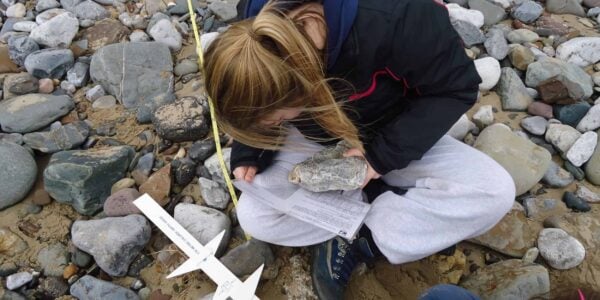
This course provides an opportunity for schools with low student numbers to tackle different fieldwork enquiries across a range of dynamic habitats.
Our environmental science courses offer:
- First-hand experience of all the required sampling techniques (ST) to gain in-depth understanding of all required methodologies (Me).
- The opportunity to use a variety of specialist fieldwork equipment useful to the study of Environmental Science including moth and mammal traps and infiltrometers.
- Enquiries set within an environmental context enabling students to gain a broad and deep understanding of real-world Environmental Science.
- Mathematical skills and the use of GIS to encourage students to interrogate and manipulate fieldwork data.
Small Group or Individual Student Days are designed to bring together individual students, home educated students, schools with small cohorts, or students who were unable to attend a residential or alternative trip. By bringing groups together you do not have to pay for a minimum number of students.
These courses are for groups of 9 or fewer students from any one school.
To ensure the safety of all participants on our day and residential small groups courses, any child, or group of children from an individual school or home-education group, aged under 18 years must be accompanied by a responsible adult, eg teacher or parent. Other adult learners eg mature students or those who have recently turned 18 are welcome to join the course.
Accompanying staff and adults are charged at half the student rate plus VAT.
Tutor: Field Studies Council Staff
Courses are led by experienced Field Studies Council staff.
Example Timetable
The following is an example of how a 5-day course might look. Our courses are as flexible as possible to meet your requirements, with other topics and skills able to be substituted into this timetable. There will be some variation between what is offered at specific centres due to habitat availability.
Day 1
Morning
Arrive Midday
- Students greeted by staff.
- Welcome talk and Centre tour.
- Pre-course meeting with staff and teachers.
- Allocation of wellies/waterproofs.
Afternoon and evening – Biodiversity
Students will consider the importance of conservation of biodiversity and how humans influence biodiversity, applying their knowledge to the specific context of a woodland, grassland or rocky shore ecosystem (centre dependent).
They will use random sampling to collect species density data in two areas of contrasting human influence and then calculate Simpson’s index of diversity. Abiotic variables will also be measured. Students will plan their methodologies considering how to ensure the data collected is representative and reliable.
A student’s t-test will be used in the follow up to aid analysis and inform conclusions.
Day 2
Morning
Freshwater Pollution Study
An investigation to establish the health of a freshwater ecosystem using invertebrate indicator species. Students will identify how identify human influence and physical landscape features contribute to pollution in local watercourses.
Data will be collected on freshwater invertebrate abundance and used to calculate biotic indices. Abiotic variables such as turbidity, light, temperature and oxygen will also be measured.
Afternoon and evening
Population Monitoring
Students will gain first-hand experience using different techniques to investigate populations of organisms in the field.
Having considered why it is important to monitor animal populations and the variety of methods that can be used, students will undertake two or three of the following investigations into populations of motile species in and around the centre.
- Investigating the effect temporal change has on populations of flying organisms. This could involve sweep netting for butterflies, and/or using bat detectors to monitor bat populations and/or moth traps.
- Using mark-release-recapture and the Lincoln Index to estimate the population size of a motile species such as woodlice or snails.
- Investigating invertebrate communities using pitfall traps.
In the follow up a chi-squared test may be used to analyse data and inform conclusions. Students will then evaluate the methods used and the strength of their study in representing larger scale applications.
Day 3
Morning and afternoon
Succession
An investigation into the process of ecological succession exploring how plant communities and associated environmental factors change over time. The habitat used will depend on the centre.
Students will use systematic sampling along a transect to collect data on species abundance and distribution, as well as various abiotic factors such as wind speed, light, soil depth and humidity
Evening
Data Analysis
Spearman’s rank correlation coefficient will be used in the analysis of data to inform conclusions.
The context specific maintenance of plagioclimax habitats through human activity will be considered.
Day 4
Morning
The Carbon Cycle
An investigation into the role of woodland in carbon storage and sequestration. Students will use a combination of fieldwork data and reference charts to calculate mean tree biomass and estimate carbon storage per hectare in a woodland.
Students will relate their own data to the wider carbon cycle and the ways in which it is being affected by human activities. They will consider the role woodland can play in sustainable management of the carbon cycle and how photosynthesis and carbon sequestration by trees can play a vital role in counteracting human activities which upset its natural equilibrium.
Afternoon and evening – Soil Analysis
Students will use a variety of practical skills to investigate soil characteristics in contrasting areas and/or changing environments in the local landscape. This will include techniques such as using data on change during heating to estimate the percentage water and organic matter composition of soil, measuring infiltration rates, using soil triangles and sedimentation to compare textures of different soils and measuring other edaphic factors such as pH and compaction.
Students will evaluate the data collected and relate their findings to broader environmental context, in particular soil management strategies to increase sustainability.
Day 5
Morning
Conservation Visit
A visit to a local site of conservation interest to see first hand examples of conservation management. Students will gain case-study knowledge of different methods used to conserve biodiversity, the legislation and protocols behind these, how and why conservation priorities are set, and examples of habitat management.
Depart at Midday
- Review of the course.
- Signposting further actions and opportunities with the FSC and beyond.
- Final farewell from staff.
Sorry this course booking is closed