Using lichens on trees as bio-indicators of air pollution
Lichens are flattened, leafy or bushy structures that grow on trees and stone and are composed of two organisms, a fungus and alga. The algal partner photosynthesises and provides food to the fungus, whilst the fungal partner provides protection.
Lichen species can be used as bioindicators of nitrogen pollution, since some species are nitrogen-tolerant and only grow on trees in polluted air, whilst other species are nitrogen-sensitive and only grow on trees in clean air. Nitrogen pollution is produced by vehicular exhausts (as nitrogen oxides) and by agriculture (ammonia gas, emitted from livestock manure and chemical fertilisers). Most nitrogen deposition occurs within 200m from the source, so the lichen species composition may indicate the air quality in the local area.
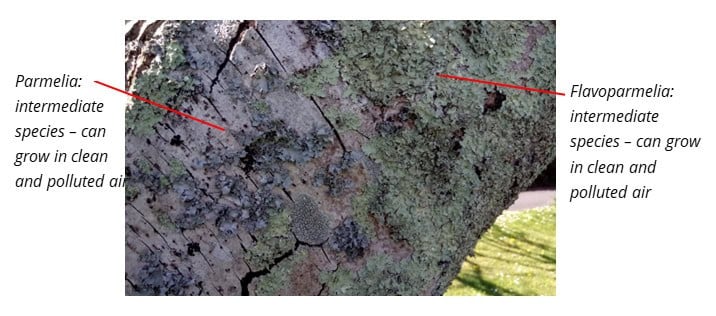
The OPAL Lichen Identification Guide shows the nine bio-indicator species
A UK survey (Wolseley et al. 2008) found that lichens growing on twigs were sensitive to lower concentrations of nitrogen pollution than those on trunks and responded earlier to changes in atmospheric conditions. The trunk may continue to support nitrogen-sensitive species, whilst the twigs become dominated by nitrogen-tolerant species. Therefore, a comparison of lichen species composition on the twigs and the trunk may indicate whether nitrogen pollution has increased or decreased in the last 8-10 years.
Activity
Design an investigation to compare the lichens on trunks and twigs on trees in locations with different air quality (e.g. trees next to a busy road versus trees in park). You will need to formulate a hypothesis or research question, design a data collection method and sampling strategy and plan how you will present and analyse your data.
You will need this identification chart.
The OPAL Air Survey booklet may help you.
If possible, use oak, ash or sycamore tree species, growing in well-lit areas (e.g. street trees or trees on the edge of woodland), with twigs (branches) that are within easy reach.
What other factors do you think could influence the species composition of lichens on the twigs compared to the trunks?
Case study: lichens on a sycamore tree adjacent to road
This sycamore tree grows next to the A381 in Totnes, a section of trunk road with nitrogen dioxide levels that regularly exceed the WHO safe limits.
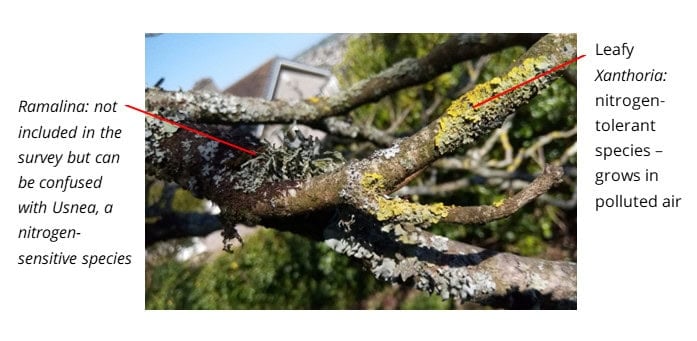
The tree supported a high abundance of the nitrogen-tolerant species Xanthoria on the twigs but there were none on the trunk, suggesting that historic air pollution was not as high as the current time.