
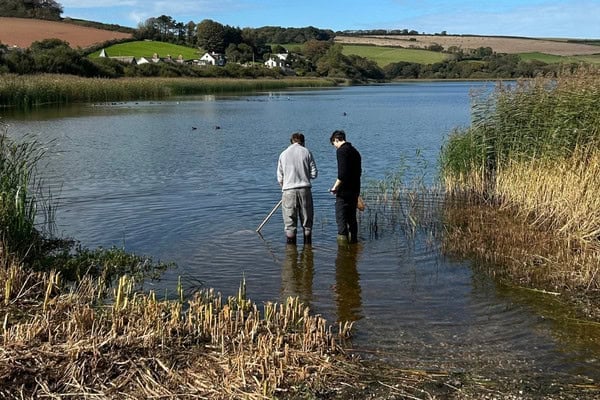
Biology fieldwork at Slapton Ley Field Centre offers rich opportunities to investigate ecological processes across a range of accessible habitats. The immediate surroundings provide a strong setting for hands‑on biological enquiry through direct observation and data collection.
Students have access to freshwater, woodland and coastal environments, including nearby rocky shore and succession sites. These habitats allow students to explore biodiversity, adaptations, succession and ecological relationships in real contexts.
Ecosystems and Biodiversity
Biological fieldwork focuses on freshwater, woodland, grassland and coastal ecosystems within the National Nature Reserve. Students investigate species diversity, adaptations and management impacts using habitats immediately surrounding the centre.
Sampling and Ecological Fieldwork
Students develop core ecological skills using quadrats, transects and sampling techniques in Slapton Wood, freshwater habitats and coastal environments. Fieldwork emphasises accurate data collection and identification within real conservation settings.
Succession
Succession is studied on the Slapton Sands shingle ridge and in woodland habitats. Students investigate changes in plant communities along abiotic gradients and examine how management influences successional pathways.
Population Ecology and Energetics
Freshwater and terrestrial habitats are used to investigate population size, trophic structure and energy flow. Invertebrate sampling supports analysis of food webs, biomass and ecosystem functioning close to the centre.
Practical Skills and Data Analysis
Biology fieldwork at Slapton integrates mathematical skills including Simpson’s Index, statistical testing and evaluation of data quality. These skills are developed through repeated practical investigation across contrasting habitats.
Slapton is particularly strong for biology due to the way its protected environments support repeated ecological investigation. Students practise key sampling techniques across contrasting habitats, strengthening identification skills, statistical analysis and evaluation. From GCSE ecology to A‑level and IB practical investigations, Slapton supports confident progression in biological fieldwork and scientific thinking.